











Unraveling the Speed of Reaction: A Deep Dive into Chemical Kinetics
Chemical kinetics is the branch of physical chemistry that explores the rates of chemical reactions and the factors that influence them. Understanding reaction rates is crucial in various fields, including industrial chemistry, environmental science, and even medicine. This article will delve deep into the principles of chemical kinetics, including basic concepts, factors affecting reaction rates, types of reactions, and methods of measuring these rates.
1. Introduction to Chemical Kinetics
Chemical kinetics assesses how quickly reactions occur and the mechanisms behind those processes. The speed at which a reaction proceeds can be influenced by various variables, including temperature, concentration of reactants, presence of catalysts, and physical state of the reactants.
1.1. Importance of Kinetics
Understanding the speed of a reaction is crucial in numerous applications:
- Industrial Processes: In manufacturing, optimizing reaction rates can reduce costs and improve safety.
- Pharmaceuticals: In drug design, knowing how quickly a drug reacts in the body can influence dosage and effectiveness.
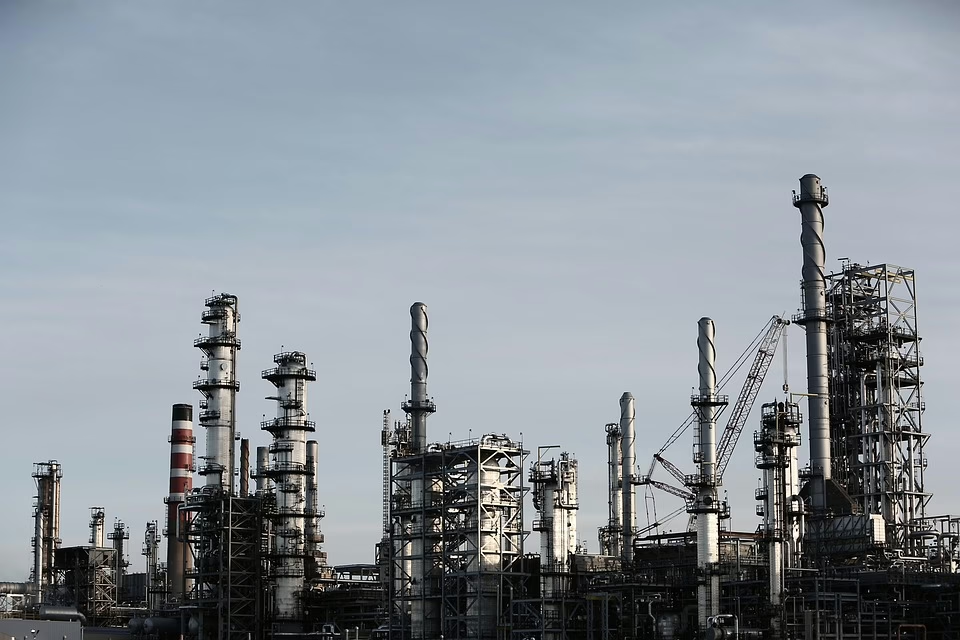
- Environmental Chemistry: Reaction rates determine how pollutants degrade in the environment, affecting remediation strategies.
2. Rate of Reaction
The rate of a chemical reaction is defined as the change in concentration of reactants or products per unit time. Mathematically, it can be expressed as:
[\text{Rate} = -\frac{d[\text{A}]}{dt} = \frac{d[\text{B}]}{dt}
]
where [A] and [B] are the concentrations of reactants and products, respectively, and ( dt ) is the change in time.
2.1. Average vs. Instantaneous Rate
-
Average Rate: This is calculated over a defined time interval, providing a general overview of how the concentration changes.
-
Instantaneous Rate: This rate is measured at a specific point in time, typically using calculus to find the slope of the concentration vs. time graph at that point.
2.2. Reaction Rate Units
The units of the reaction rate depend on the reaction order. Commonly, reaction rates are expressed in mol/L·s (molarity per second). However, for different reactions, the units may vary similarly to how we consider the rate of a car in miles per hour versus meters per second.
3. Factors Affecting Reaction Rates
Several factors can affect how quickly a reaction occurs:
3.1. Concentration of Reactants
In general, increasing the concentration of reactants will increase the rate of reaction. This happens because a higher concentration means more molecules are available to collide, leading to more successful reactions.
3.2. Temperature
Temperature plays a crucial role in reaction rates because it affects the kinetic energy of molecules. According to the Arrhenius Equation:
[k = A e^{-\frac{E_a}{RT}}
]
where ( k ) is the rate constant, ( A ) is the pre-exponential factor, ( E_a ) is the activation energy, ( R ) is the universal gas constant, and ( T ) is the temperature in Kelvin. As temperature increases, the number of molecules that have sufficient energy to overcome the activation energy barrier also increases.
3.3. Catalysts
Catalysts are substances that speed up reactions without being consumed in the process. They work by providing an alternative pathway with a lower activation energy. This can significantly increase the reaction rate by allowing more molecules to react at a given temperature.
3.4. Physical State of Reactants
The physical state—solid, liquid, or gas—also affects how quickly a reaction proceeds. Gaseous reactants generally react more quickly than solids or liquids because their molecules are farther apart, resulting in more frequent collisions.
4. Order of Reaction
The order of a reaction indicates how the rate depends on the concentration of reactants.
4.1. Zero-Order Reactions
In zero-order reactions, the rate of reaction is constant and does not change with the concentration of reactants.
[\text{Rate} = k
]
The concentration of reactants decreases linearly over time, and the rate constant ( k ) can be derived from the integrated rate equation:
[[\text{A}] = [\text{A}]_0 – kt
]
where ( [A]_0 ) is the initial concentration.
4.2. First-Order Reactions
In first-order reactions, the rate is directly proportional to the concentration of one reactant. The integrated rate equation is:
[\ln[\text{A}] = \ln[\text{A}]_0 – kt
]
4.3. Second-Order Reactions
In these reactions, the rate depends on the concentrations of two reactants or the square of the concentration of one reactant:
[\text{Rate} = k[\text{A}]^2 \quad \text{or} \quad \text{Rate} = k[\text{A}][\text{B}] ]
The integrated rate equation for a second-order reaction is more complex but can generally be expressed as:
[\frac{1}{[\text{A}]} = \frac{1}{[\text{A}]_0} + kt
]
4.4. Mixed-Order and Complex Reactions
Some reactions do not fit neatly into one of these categories and are termed mixed-order or complex reactions.[1]
5. Reaction Mechanism
Unraveling the mechanisms of chemical reactions helps to explain how reactants transform into products. A reaction mechanism involves a series of steps, including elementary reactions, that lead to the overall transformation.
5.1. Elementary vs. Complex Reactions
-
Elementary Reaction: These are single-step processes where the reaction rate is determined by the stoichiometry of that step.
-
Complex Reaction: Involves multiple elementary steps. The rate law for such reactions can be deduced from the slowest elementary step, often referred to as the rate-determining step.
5.2. Reaction Intermediates
Intermediates are species that appear in the mechanism but not in the overall balanced equation. Their presence influences the reaction rate and can be detected experimentally.[2]
6. Measuring Reaction Rates
Several techniques exist to measure reaction rates, with methods varying based on the type of reaction and measurement desired.
6.1. Concentration Measurements
One common approach is to measure the change in concentration of reactants or products over time. This can be done using spectrophotometry or chromatography.
6.2. Gas Volume Measurement
For reactions producing gases, monitoring the volume of gas released can provide a direct measure of the reaction rate.
6.3. Pressure Changes
For reactions involving gases, changes in pressure can also be used to track reaction rates using methods like manometry.
7. Conclusion
Understanding chemical kinetics provides valuable insights into the mechanisms and rates of chemical reactions, which are fundamental to numerous scientific and industrial applications. By studying the factors that affect reaction rates—such as concentration, temperature, and catalysts—scientists can optimize processes, develop new technologies, and better understand natural phenomena.
7.1. Future Directions
As technology advances, especially in computational chemistry, researchers are poised to gain even deeper insights into reaction mechanisms and kinetics. This could lead to breakthroughs in materials science, environmental chemistry, and drug development.[3]
References
- M. R. Wright, “Reaction Kinetics: Basics and Applications,” Chemical Reviews, vol. 117, no. 4, pp. 1237-1300, 2017.
- A. Smith, “Role of Intermediates in Complex Reaction Mechanisms,” Journal of Physical Chemistry A, vol. 121, no. 30, pp. 5695-5703, 2019.
- J. A. Robinson and P. K. Patel, “Advances in Computational Kinetics: Modelling Reaction Pathways,” Accounts of Chemical Research, vol. 53, no. 5, pp. 1023-1031, 2020.





Add Comment