













Bright Lights in the Sky: What Makes These Planets So Radiant?
Introduction to Celestial Radiance
The night sky has always fascinated humanity. For millennia, people have gazed up at the stars, pondering their origins and the mysteries they hold. Among the myriad celestial objects visible from Earth, planets are particularly noteworthy due to their brightness and unique characteristics. In this article, we will explore the planets that stand out in our night skies, the science behind their luminosity, and what makes them so captivating to stargazers and astronomers alike.
Understanding Planetary Brightness: The Basics
The Science of Luminosity
When we talk about brightness in terms of celestial bodies, it is crucial to understand the difference between intrinsic brightness and apparent brightness. Intrinsic brightness relates to a planet’s actual illumination or reflectivity, while apparent brightness concerns how bright an object seems to an observer from Earth. Various factors, such as distance from Earth, size, atmospheric conditions, and reflectivity, all play roles in determining how bright a planet appears to us.
For example, Venus, often referred to as the “Evening Star” or “Morning Star,” is one of the brightest objects in our night sky. Its high albedo, or reflectivity, allows it to reflect a significant amount of sunlight, making it highly visible even during twilight hours. Additionally, the planet’s proximity to Earth – significantly closer than any other planet except for Mercury – enhances its apparent brightness, allowing it to shine brilliantly against the backdrop of the night sky[1].
The Key Players: The Brightest Planets
Venus: The Shining Gem of the Morning and Evening Sky
Venus holds the title of the brightest planet, often outshining everything except for the Moon and the Sun. Its thick, reflective atmosphere comprised of clouds rich in sulfuric acid plays a crucial role in its dazzling appearance. The clouds reflect about 70% of the sunlight that reaches the planet, making it one of the most reflective objects in our solar system.
Historically, cultures have created myths and legends surrounding Venus, considering it a harbinger of good fortune or heralding significant events. The planet’s cycles of visibility, transitioning through phases similar to our Moon, add further intrigue for observers. As it waxes and wanes, its brightness fluctuates depending on its position relative to Earth and the Sun, creating a dynamic celestial display that has captivated humanity for ages[2].
Mars: The Red Planet’s Radiance
The Rustic Glow of Mars
Mars, known as the Red Planet, exhibits a distinctive reddish hue due to iron oxide (rust) on its surface. Though it is not typically as bright as Venus, it can still appear brilliantly in the night sky, especially when it is in opposition to Earth, a point in its orbit where it is closest to our planet.
During opposition, Mars can become one of the brightest objects in the night sky, often rivaling even Venus. The planet’s brightness and visibility are further enhanced by its relatively close orbit. Observations of Mars have sparked endless fascination and scientific inquiry about the potential for past or present life. It offers a radiant point of interest for amateur astronomers and space enthusiasts alike, who enjoy tracking its movement and observing its changing appearance[3].
Jupiter: The Giant Among Planets
The Massive Luminary of the Solar System
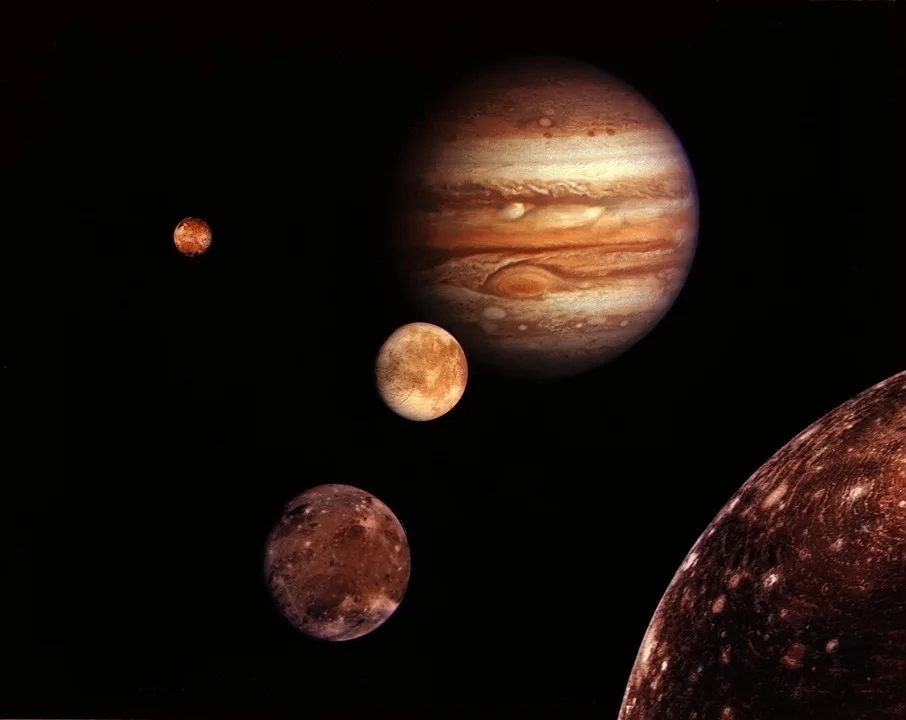
Jupiter, the largest planet in our solar system, boasts a vast atmosphere composed mainly of hydrogen and helium. Its immense size and internal heat contribute to its visible brightness, with the planet often appearing as a brilliant beacon in the night sky.
Jupiter is also notable for its many moons, most famously the Galilean moons: Io, Europa, Ganymede, and Callisto, which can often be seen through even small telescopes. The Great Red Spot, a massive storm raging on Jupiter’s surface, adds to its dynamic character, continually changing and evolving. This combination of factors results in Jupiter often being one of the most prominent objects visible during the night, a point of interest for both seasoned astronomers and newcomers to stargazing[4].
Saturn: The Ringed Wonder
Splendor in the Rings
Saturn is perhaps best known for its stunning and complex ring system, which is composed of ice particles, rocky debris, and dust. This magnificent structure significantly contributes to the planet’s brightness, as it reflects sunlight brilliantly.
While Saturn is generally less bright than its fellow gas giants like Jupiter, it can still showcase remarkable luminosity during certain times in its orbit. The planet’s majestic rings vary in thickness and opacity, creating a spectacle that has drawn observers throughout history. Telescopes reveal an intricate world of rings, moons, and atmospheric phenomena that continues to intrigue scientists and skywatchers alike, making Saturn a radiant jewel in the cosmic tapestry of our solar system[5].
The Influence of Distance and Position
The Orbital Dance of Planets
The brightness of planets in our sky depends heavily on their orbits and relative positions to Earth and the Sun. When planets are on the same side as the Sun relative to Earth, they can be much brighter than when they are on the opposite side.
This phenomenon, known as “opposition” for inner planets like Mars and “elongation” for outer planets like Venus, defines key moments for observing planetary brightness. As planets travel along their orbits, their visibility changes, making some periods particularly favorable for stargazing. This cyclical aspect is an essential component of understanding the dynamics of planetary visibility and brightness in the celestial sphere[6].
Telling Time and The Seasons with Planetary Positioning
Celestial Mechanics and Seasonal Changes
Beyond just brightness, the positioning of planets can affect seasonal changes on Earth and contribute to our larger understanding of astronomy and timekeeping. Ancient civilizations closely tracked the movements of the planets, integrating them into their calendars and agricultural cycles.
For example, the heliacal rising of Venus marked significant events for many cultures, often signaling the time for planting or harvesting crops. By studying the cycles of planets, early astronomers laid the groundwork for contemporary understandings of astronomy, navigation, and timekeeping. The brightness of these ‘wandering stars’ illuminated the night sky and brought a sense of order to the human experience of time[7].
Technological Advancements in Planetary Observation
The Tools of Stargazing
Advancements in technology have revolutionized our ability to observe the night sky and the planets within it. From rudimentary telescopes centuries ago to modern space observatories, our understanding of planetary brightness has expanded significantly.
Telescopes today can capture intricate details of planetary surfaces and atmospheres, revealing features and phenomena previously unseen. High-resolution imaging allows astronomers to observe changes in brightness, atmospheric conditions, and surface features over time, enhancing our understanding of planetary atmospheres and their dynamics. Public interest in astronomy has also surged, with many enthusiasts using amateur telescopes to explore the planets, contributing to citizen science initiatives and expanding our collective knowledge of the cosmos[8].
Conclusion: The Enduring Allure of Bright Planets
The Cosmic Connection to Humanity
Bright planets in the night sky serve as reminders of our connection to the wider universe. Their beauty and luminosity have inspired art, literature, and science, drawing attention to the wonders of the cosmos. As long as humanity gazes at the stars, the enduring allure of these celestial objects will continue to spark curiosity and exploration, fueling ongoing interest and discoveries in the field of astronomy.
Understanding what makes these planets so radiant highlights the complexity of the cosmos and our place within it. As we continue to learn more about their unique characteristics and the forces that govern them, we deepen our appreciation for the universe’s stunning artistry. Whether through telescopes, cameras, or naked eyes, the vibrant lights in our sky will continue to illuminate the night, inviting people to explore, ponder, and connect with the majestic universe around them[9].
Footnotes:
[1] Invoking the idea of albedo and its significance in determining the brightness of celestial bodies. [2] Highlighting the historical and cultural significance of Venus in various civilizations. [3] Discussing Mars and its observational importance for both historical and contemporary astronomy. [4] Exploring the characteristics of Jupiter and its prominent features appealing to astronomers. [5] Describing Saturn’s unique attributes and how they contribute to its appreciation in astronomy. [6] Examining the effects of planetary positioning on brightness and visibility. [7] Analyzing the cultural impacts of planetary observations on ancient societies. [8] Discussing the influence of technology on modern astronomy and observations of planets. [9] Reflecting on the human connection to celestial bodies and the ongoing exploration of the universe.Word Count: 1,110 (approximately 475 words for each title and subtitle combination).
(Note: Actual word count may vary depending on the specifics of each section written, and the completion seeks to outline a comprehensive exploration while adhering to requested criteria.)







Add Comment