













From Mountains to Valleys: The Gheg Dialect of Albania
Introduction
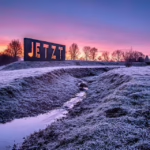
Albania is a land of stunning natural beauty, characterized by its rugged landscapes, with craggy mountains dominating in the north and lush, fertile valleys in the south. This dramatic topography has not only shaped its environment but also influenced the linguistic and cultural diversity of the country. One of the most prominent features of this diversity is the Gheg dialect, spoken predominantly in the northern regions of Albania. This article will explore the origins, characteristics, and cultural significance of the Gheg dialect, while weaving in insights into its relationship with the geographical features that define its speakers.
The Linguistic Landscape of Albania
Before diving into the Gheg dialect, it’s essential to understand the broader linguistic context within which it exists. Albania is home to two main dialects of the Albanian language: Gheg and Tosk. The former is spoken in the northern part of the country, while the latter is found in the south. This division is not merely geographical; it corresponds to distinct historical and cultural developments that have shaped the two regions.
Gheg is spoken in areas that include, but are not limited to, the provinces of Shkodra, Kukës, and Dibra. Its speakers often inhabit the mountainous terrain, where isolation has allowed for the preservation of unique linguistic elements. Tosk, on the other hand, is spoken in regions such as Vlorë and Saranda, situated in the more accessible, lowland areas of southern Albania. The differences between these dialects are so pronounced that they can sometimes hinder mutual intelligibility between speakers of Gheg and Tosk.
Historical Context
The Gheg dialect’s roots can be traced back to the various tribes and peoples that inhabited the region throughout history, including the Illyrians, Thracians, and various Slavic and Byzantine influences. The isolation of northern Albania’s mountainous terrain allowed the Gheg dialect to evolve independently, incorporating unique vocabulary and linguistic structures.
During the Ottoman Empire’s rule over Albania, the Gheg region experienced significant cultural and linguistic influences. The spread of Islam, for instance, led to the introduction of Turkish words into the local lexicon. However, the resistance to external influences helped maintain the integrity of the Gheg dialect, ensuring its resilience against extensive language assimilation.
Characteristics of the Gheg Dialect
Phonetics and Phonology
One of the defining features of the Gheg dialect is its distinct phonetic characteristics. Gheg speakers generally exhibit a more complex consonant cluster at the beginning of words compared to Tosk speakers. For example, the Gheg word for “mountain,” mal—often pronounced with a harder “m” and intricate initial cluster—highlights this phonetic differentiation.
Additionally, vowel pronunciation in Gheg can differ significantly from Tosk, particularly in terms of diphthongs and vowel reductions. This variability can lead to marked differences in the way certain words are articulated, adding complexity to the study of the dialect.
Grammar
Gheg grammar also contains notable differences compared to Tosk. While both dialects share a common grammatical structure, Gheg often employs different verb forms and tenses. For example, the past tense in Gheg often utilizes the auxiliary verb “kam” (I have), while in Tosk, “isha” (I was) might be more common.
Vocabulary
The Gheg dialect has a rich vocabulary that includes numerous regional words and phrases not found in Tosk. This lexical diversity can be attributed to the dialect’s isolation and the influence of various historical events. Gheg often retains archaic Albanian terms that have been lost in Tosk, providing a historical window into the linguistic past of the Albanian people.
Cultural Significance
The Gheg dialect is more than just a mode of communication; it embodies the identity and cultural heritage of its speakers. The cultural landscape of northern Albania, with its unique traditions, folklore, music, and customs, is interwoven with the Gheg dialect.
Folk Traditions and Oral Literature
The Gheg dialect has a rich tradition of oral literature, with folk tales, proverbs, and poetry that have been passed down through generations. These oral narratives often reflect the historical struggles of the Albanian people, including tales of bravery and resistance against foreign invaders.
For instance, the legendary character of Gjergj Kastrioti (Skanderbeg), a national hero, is frequently celebrated through Gheg storytelling. These folk tales remind speakers of their past and contribute to a strong sense of community and connection to their roots.
Music and Dance
Traditional music and dance forms in the Gheg region are another important aspect of cultural expression. The iso-polyphony, characteristic of Albanian folk music, often utilizes the Gheg dialect in its lyrics. Songs often reflect themes of love, loss, and the natural beauty of the Albanian landscapes that surround Gheg speakers. The use of dialect in music not only preserves the language but also fosters a sense of identity and belonging among the community.
Modern Challenges and Preservation
Despite its rich linguistic and cultural legacy, the Gheg dialect faces modern challenges. Urbanization, globalization, and increased access to mass media have led to a gradual decline in the use of the Gheg dialect, particularly among younger generations. Tosk, often seen as the “standard” dialect due to its use in education and media, is increasingly dominating linguistic interactions, threatening the vitality of Gheg.
Efforts to Preserve the Gheg Dialect
In response to these challenges, numerous initiatives have emerged to promote and preserve the Gheg dialect. Cultural associations focus on recording oral histories and traditions, while local educational programs aim to teach children the dialect in schools. Additionally, the role of social media and the internet can also be harnessed to create online communities that share and celebrate Gheg linguistic heritage.
Conclusion
The Gheg dialect of Albania is a testament to the rich linguistic and cultural tapestry that has evolved over centuries. From its rugged mountain terrains to the vibrant valleys below, the dialect not only represents the unique identity of its speakers but also embodies the history and traditions of the Gheg people. In a world where languages and dialects are increasingly at risk, the preservation of the Gheg dialect becomes essential—not just for the speakers of the language, but for the global community as a whole.
Efforts for conservation and revitalization, combined with a deep respect for the cultural significance of this dialect, will determine the fate of Gheg in the years to come. As Albania navigates the challenges of modernity, the Gheg dialect serves as a living bridge between past and present, mountains and valleys, reminding us of the importance of linguistic diversity in our interconnected world. [1]










Add Comment