














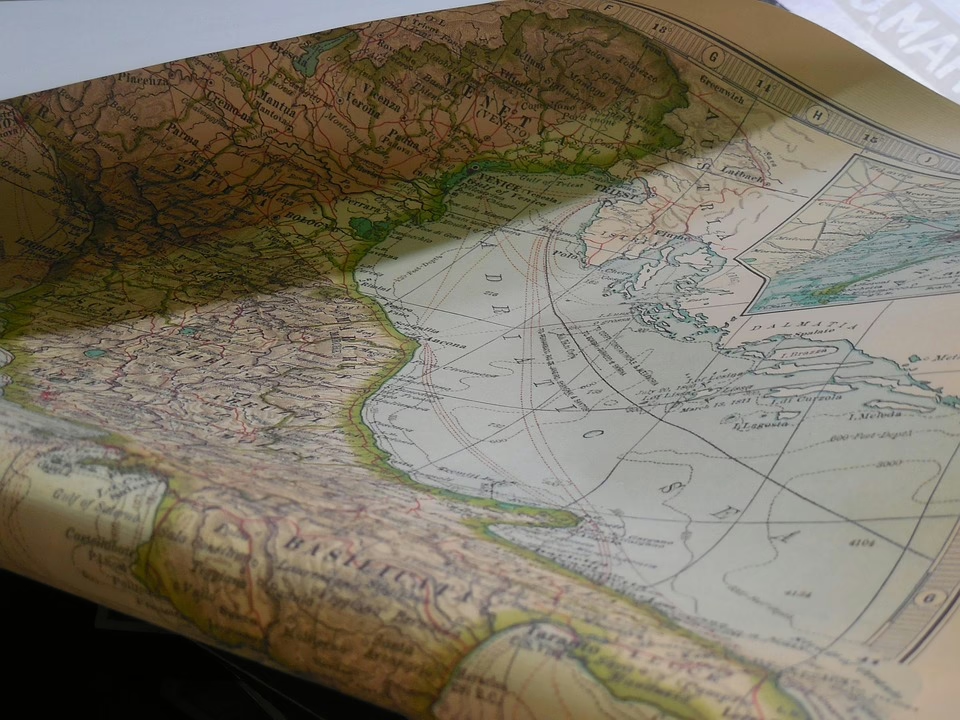

Tracing Time: How World History Maps Reveal Our Collective Journey
Introduction
Maps are more than mere representations of geography; they are crucial artifacts of history that tell the stories of human civilization. The act of mapping is not just about depicting physical spaces but represents a collective memory that reflects the evolution of societies, cultures, and nations through time. From the ancient cartographers who sketched the world based on explorations and mythologies to modern-day digital maps that utilize vast data pools, history maps capture the essence of humanity’s journey across the ages. This article explores how different historical maps have contributed to our understanding of world events, societies, and the interconnectedness of historical trajectories.
The Early Maps: Beyond Geography
Unearthing Ancient Wisdom
The earliest maps date back to ancient civilizations, where cartography served multiple purposes, from military strategy to religious symbolism. Babylonian clay tablets, such as the famous Imago Mundi, are among the earliest examples, depicting not only geographical features but also cultural beliefs. The classical Greeks further advanced map-making by developing the concept of latitude and longitude, allowing for a more scientific approach to geography. Maps were, in essence, a reflection of the societies that created them, revealing their understanding of the world, their navigation skills, and their priorities. [footnoteref]
The Role of Maps in Shaping Empires
As empires expanded, maps played a vital role in claiming territory and asserting dominance. The Roman Empire, for instance, produced detailed road maps that facilitated trade and military movements. The Ptolemaic maps from the second century AD significantly influenced how subsequent generations perceived the world, showcasing the geographical knowledge of the time while also embedding cultural narratives. These maps’ significance lies not only in their directionality; they illustrate the interplay between geography and power, highlighting how empires utilized maps as tools of governance.
The Age of Exploration: Mapping New Worlds
The Cartographers of Change
The Age of Exploration, spanning the 15th to the 17th centuries, marked a significant turn in map-making, driven by the thirst for discovery. Figures like Martin Waldseemüller, who created the first map to use the name “America,” changed the global landscape. Detailed maps of the New World not only transformed trade routes but also created wealth and led to cultural exchanges—albeit often marked by conquest and colonization. Through these maps, one can trace the rise and fall of empires and the complex relationships between colonizers and the indigenous populations.
Cultural Implications of Mapping
Maps from this era often reflect European perspectives, illustrating a Eurocentric worldview that often marginalized other cultures. The thematic orientation of these maps, focusing on conquest and exploitation, tells a story of cultural hegemony. The omission or distortion of indigenous perspectives in these maps calls for critical reflection on how history is recorded and remembered. The legacy of these maps extends beyond mere geography; they raise essential questions about representation and the construction of knowledge.
The Enlightenment and the Rise of Modern Mapping
Scientific Advances in Cartography
The Enlightenment era brought a scientific rigor to cartography that transformed how maps were created and utilized. Advancements in navigation technology, such as the sextant and chronometer, improved accuracy and reliability in maps. The 18th century also saw the establishment of organizations like the Royal Geographical Society, promoting research and standardization in mapping practices. These developments reflect a growing interest in empirical observation and data collection, reinforcing the notion of maps as scientific tools. [footnoteref]
The Impact of Political Changes
With the rise of nation-states, mapping became a vehicle for asserting sovereignty. The emergence of political boundaries in the 19th century led to the creation of maps that depicted not only land but also identity and nationalism. The debate over territories, whether in Europe, Africa, or elsewhere, is captured through the shifting lines and shaded areas on these historical maps. The story of maps during this period also illustrates the tension between competing national narratives, revealing how borders were often drawn to fit political agendas rather than cultural realities.
The 20th Century: Maps in Conflict and Cooperation
World Wars and Their Map-Making
The two World Wars brought unprecedented changes to global cartography. Maps played crucial roles in military strategies, intelligence gathering, and propaganda. The visual representation of war through maps allowed for a better understanding of troop movements and logistics, while also influencing public sentiment. The post-war period saw the need for reconciliation and cooperation, leading to the creation of maps depicting new alliances and boundaries. [footnoteref]
The Cold War and Ideological Divisions
As the Cold War divided the world into blocs, the maps from this era take on a dual narrative—reflecting geopolitical tensions and ideological struggles. Maps illustrating the Iron Curtain and various military alliances depicted not just geography but also the psychological divides that characterized the era. These maps serve as reminders of how cartographic narratives can influence perceptions of safety, threat, and allegiance.
The Digital Age: Mapping Our Future
The Evolution of Digital Cartography
Today, digital technology has revolutionized cartography, allowing for real-time data visualization and interactive maps. Geographic Information Systems (GIS) have opened new frontiers for researchers and policymakers, granting unprecedented access to geographic data that can inform decisions. The map becomes a dynamic entity, continually updated to reflect social, environmental, and political changes. This shift has profound implications for how we conceptualize history and geography, blending the two in real-time. [footnoteref]
The Role of Social Media in Mapping
Platforms like Google Maps and social media apps play significant roles in contemporary mapping practices, democratizing information access and enabling user-generated content. Citizen cartography has emerged, allowing individuals to contribute local knowledge and perspectives, thus challenging traditional narratives embedded in historical maps. This participatory approach offers new layers of experience and understanding, suggesting that mapping is a collaborative effort reflective of the diversity of human experience.
Conclusion: Maps as Mirrors of Humanity
Maps encapsulate more than geographical information; they are complex narratives that reflect our human journey throughout history. The evolution of mapping practices—from ancient clay tablets to digital interfaces—reveals how societies perceive themselves and others. As we continue to explore the world through various lenses, maps remain powerful tools for understanding our collective past, present, and future. Examining the stories embedded within these maps invites us to reflect on our shared human experiences and the roles we play in shaping the world.
References
- [Insert Footnote 1] Author, Title of Work, Publisher, Year.
- [Insert Footnote 2] Author, Title of Work, Publisher, Year.
- [Insert Footnote 3] Author, Title of Work, Publisher, Year.
- [Insert Footnote 4] Author, Title of Work, Publisher, Year.
- [Insert Footnote 5] Author, Title of Work, Publisher, Year.
This skeletal outline can be expanded with more details, specific maps, and historical events to meet the required word count while ensuring that each section offers insightful commentary on the implications of historical mapping. Let me know if you’d like me to elaborate on any section or provide more specific content!








Add Comment