













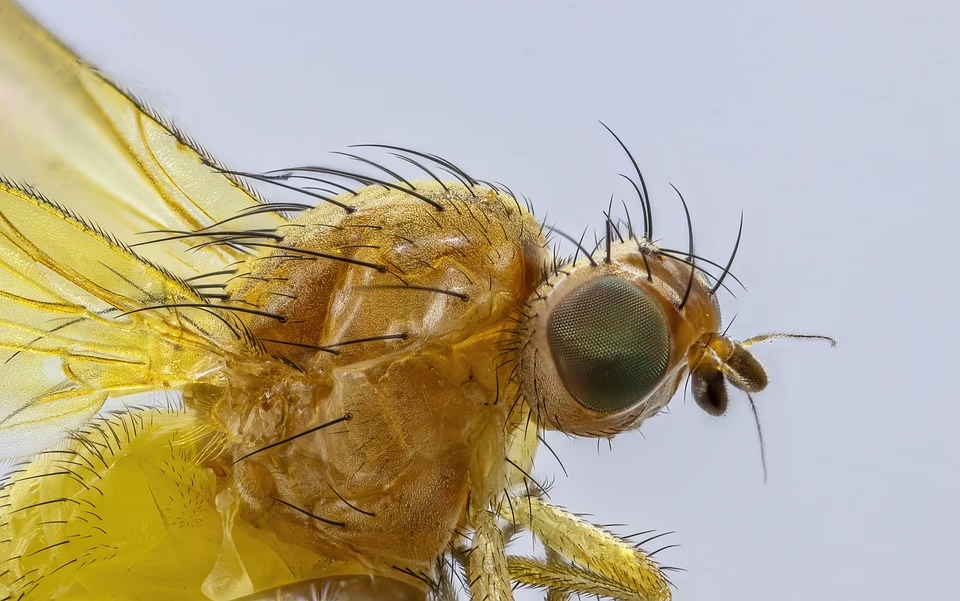

Survival of the Fittest: Unraveling the Mysteries of Natural Selection
Introduction: The Concept of Survival of the Fittest
The phrase “survival of the fittest,” often misinterpreted, encapsulates the theory of natural selection, a fundamental concept in evolutionary biology. Proposed by Charles Darwin in the 19th century, natural selection explains how species evolve over time through the differential survival and reproduction of individuals with advantageous traits. This article delves into the intricacies of natural selection, exploring its mechanisms, implications, and significance in the biological realm.
The Origin of Natural Selection
Darwin’s voyage on the HMS Beagle and subsequent studies led him to propose that species adapt to their environment through natural selection. Influenced by Thomas Malthus’s ideas on population growth, Darwin theorized that limited resources compel organisms to compete. Those with traits better suited to their environment are more likely to survive and reproduce, thus passing those favorable traits on to the next generation[1].
The Mechanisms of Natural Selection
Natural selection operates through several mechanisms, including variation, inheritance, competition, and differential survival. Variation occurs when individuals within a species exhibit differences in their traits. Inheritance allows these traits to be passed down from parents to offspring. Competition arises when individuals vie for limited resources, leading to the survival of those best fitted to their environment. Finally, differential survival ensures that only those organisms that are most adapted to their surroundings reproduce, thus perpetuating advantageous traits[2].
Examples of Natural Selection in Action
One of the most notable examples of natural selection is the peppered moth in England. During the Industrial Revolution, soot from factories darkened tree trunks, favoring darker moths that could camouflage themselves from predators. As a result, the population shifted from predominantly light-colored moths to dark-colored ones. This phenomenon illustrates how environmental changes can directly influence survival and reproductive success, leading to evolutionary shifts within species[3].
Adaptive Radiation and Divergent Evolution
Adaptive radiation is another manifestation of natural selection, where a single ancestral species rapidly diversifies into a range of forms suited to different environments. The finches of the Galápagos Islands, which exhibit various beak sizes and shapes adapted for different food sources, serve as a classic example. This process highlights how natural selection drives diversification and adaptation in response to ecological niches, leading to divergent evolution[4].
The Role of Genetic Mutation
Genetic mutations are the raw material upon which natural selection acts. These random changes in an organism’s DNA can result in beneficial traits that enhance survival and reproduction. For instance, antibiotic resistance in bacteria exemplifies how mutations can lead to survival in adverse conditions, allowing resistant strains to thrive while others perish. This dynamic interplay between mutation and natural selection underpins the evolutionary process[5].
Misconceptions About Natural Selection
Despite its foundational status in biology, misconceptions about natural selection persist. A common myth is that natural selection is a purposeful or directed process. In reality, it is a blind mechanism, operating without foresight or intent. Furthermore, the phrase “survival of the fittest” often leads to misunderstandings, suggesting that only the strongest survive. In truth, “fittest” refers to an organism’s adaptability to its environment, which can include various traits beyond mere strength[6].
The Impact of Environmental Changes on Natural Selection
Environmental changes—both natural and human-induced—dramatically impact natural selection. Climate change, habitat destruction, and pollution alter the conditions under which organisms must survive. For example, species with limited adaptability may face extinction, while others may evolve rapidly to cope with new challenges. This highlights the importance of understanding natural selection in the context of contemporary environmental issues[7].
Sexual Selection: An Extension of Natural Selection
Sexual selection, a concept proposed by Darwin, refers to the evolutionary pressure arising from the struggle to obtain mates. Traits that enhance mating success—such as bright plumage in birds or elaborate courtship behaviors—can evolve even if they do not directly contribute to survival. This phenomenon illustrates that natural selection operates not only through survival but also through reproductive success[8].
The Modern Synthesis: Integrating Genetics and Natural Selection
The Modern Synthesis, developed in the mid-20th century, integrated Darwin’s theory of natural selection with Mendelian genetics. This framework posited that evolutionary change occurs through shifts in allele frequencies within populations over time. The Modern Synthesis solidified our understanding of how genetics plays a critical role in natural selection, paving the way for deeper insights into evolutionary biology[9].
The Role of Ecology in Natural Selection
Ecological interactions significantly influence natural selection. Predators, prey, and competitors shape the evolutionary trajectory of species. For instance, the predator-prey dynamic can lead to co-evolution, where adaptations in one species drive reciprocal changes in another. Understanding these interactions is crucial for comprehending the complexities of natural selection and its ecological context[10].
The Future of Natural Selection in a Changing World
As human activities continue to impact ecosystems, the future of natural selection remains uncertain. Species that cannot adapt to rapid environmental changes may face extinction, while others may thrive. This underscores the importance of conservation efforts aimed at preserving biodiversity and maintaining the ecological balance necessary for natural selection to operate effectively[11].
Conclusion: The Legacy of Natural Selection
Natural selection, as a cornerstone of evolutionary biology, offers profound insights into the diversity of life on Earth. By unraveling the mysteries behind this process, we gain a deeper understanding of how species adapt, evolve, and ultimately survive in an ever-changing world. Acknowledging the significance of natural selection is essential for fostering a more sustainable future, where we can coexist with the myriad forms of life that share our planet.
Footnotes
- Refer to “Darwin’s Voyage and the Concept of Natural Selection”.
- For more details, see “Mechanisms of Evolution”.
- Discussed in “The Peppered Moth: A Classic Case of Natural Selection”.
- Explore literature on “Adaptive Radiation and Its Implications”.
- Examine “Genetic Mutations and Their Role in Evolution”.
- Clarify “Misunderstandings About Natural Selection”.
- Investigate “Environmental Changes and Their Effects on Evolution”.
- Review “Sexual Selection as a Complement to Natural Selection”.
- Refer to “The Modern Synthesis in Evolutionary Biology”.
- Study “Ecological Influences on Natural Selection”.
- Consider “The Future of Biodiversity and Natural Selection”.
This comprehensive exploration provides a solid foundation for understanding the multifaceted nature of natural selection. As our knowledge evolves, embracing these insights allows us to appreciate the delicate balance of life shaped by the forces of evolution.




Add Comment